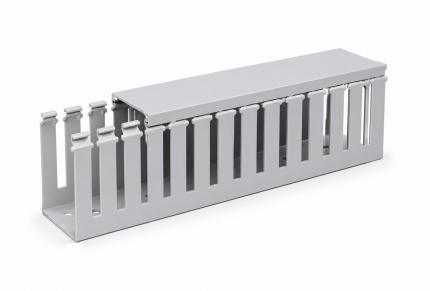
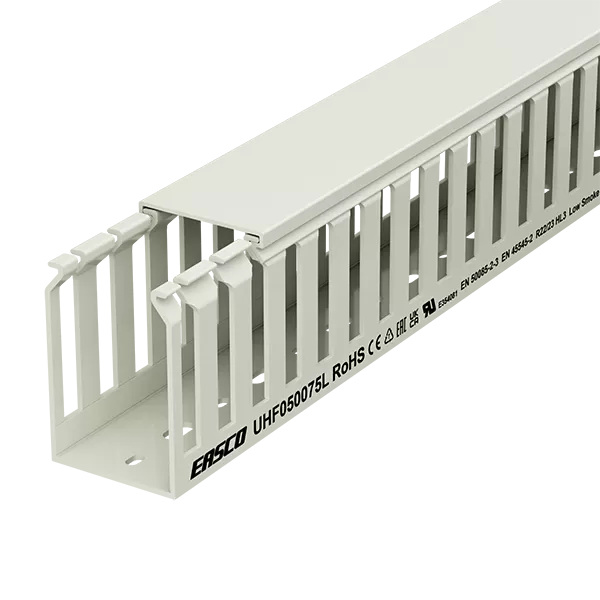
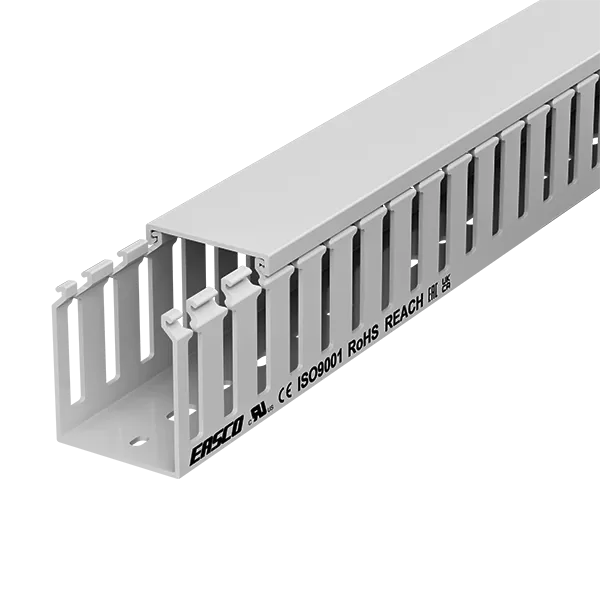
PVC wiring ducts should be selected according to the cable volume, panel layout, wire exit points, operating environment, installation method, and future expansion requirements. For densely wired electrical cabinets, slotted ducts generally provide the best balance between cable protection and installation flexibility. Solid-wall ducts are more suitable for continuous cable routes where frequent wire branching is not required.
A well-selected PVC wiring duct does more than make a control panel look organized. It reduces pressure on cable insulation, maintains separation between different circuits, supports faster maintenance, and gives installers enough room to modify the system without rebuilding the entire cable route.
PVC wiring ducts are used to organize, route, protect, and separate wires inside electrical panels, distribution cabinets, machinery, automation equipment, and other enclosed electrical systems. The duct provides a defined path for conductors, while a removable cover keeps the wiring contained but accessible.
Typical applications include:
Industrial control cabinets
PLC and automation panels
Power distribution equipment
Switchgear assemblies
Machine control systems
HVAC control panels
Renewable energy equipment
Telecommunications cabinets
Railway and transportation systems
Within these applications, wires frequently run between circuit breakers, relays, contactors, terminal blocks, controllers, power supplies, drives, and sensors. Without a structured cable route, conductors can cross over components, obstruct maintenance access, or become difficult to identify.
The same product may be described as PVC wiring ducts, PVC cable duct, cable duct PVC, or PVC duct for electrical cables. In European and international search markets, terms such as kabel duct, kabel ducting, and kabel duct PVC are also commonly used for similar cable-management products.
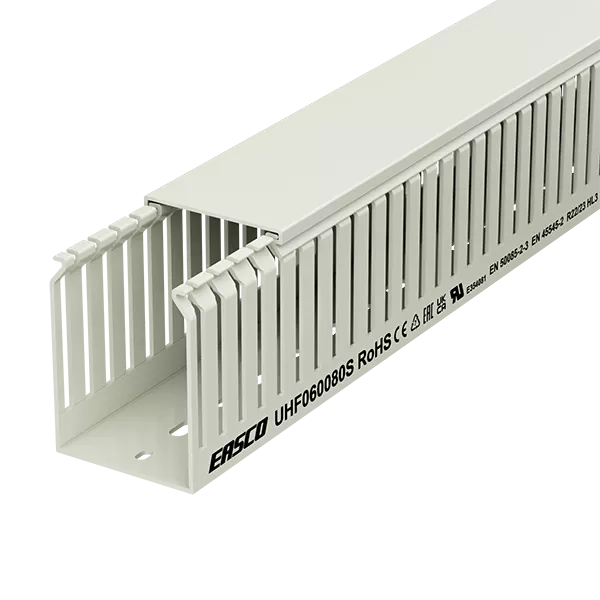
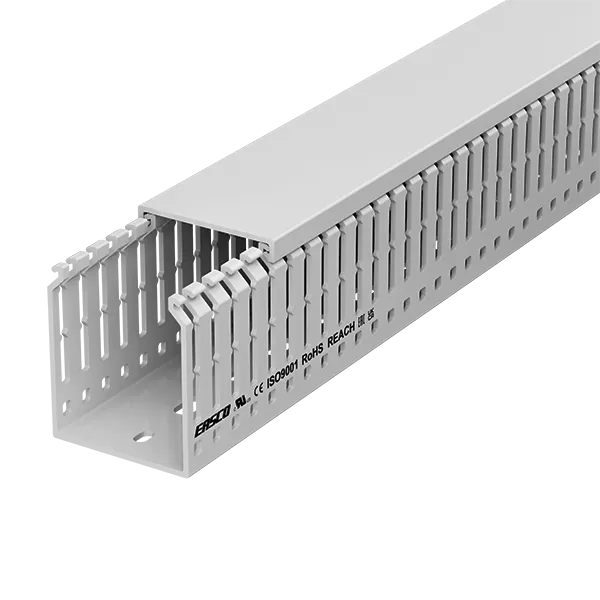
EASCO’s product range includes open-slot, finger-breakable, and solid wiring ducts, together with covers and internal dividers. Its listed PVC products use slotted side walls, smooth edges, and snap-on covers to support cable installation and later maintenance.
The primary difference is the way cables enter and leave the duct.
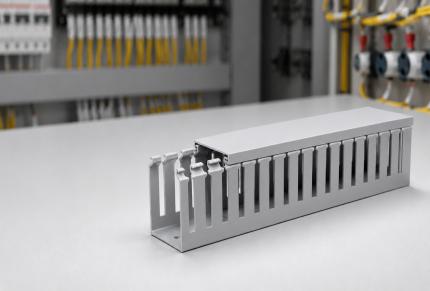
A slotted duct has regularly spaced openings along its side walls. Individual wires can exit through the slot nearest to the component they connect to. This structure is particularly useful in control panels containing many terminal points.
Slotted kabel ducting PVC offers several operational advantages:
Cables can enter or leave at multiple positions
Shorter wire routes can be created between the duct and components
Circuit changes can be completed without removing the entire wire bundle
Individual conductors are easier to trace
Power, signal, and control wires can be arranged more systematically
Slot width and finger spacing should be selected according to the cable size and the density of the connections. Narrow slots provide more exit positions for smaller control wires. Wider slots may be more practical for larger cables or grouped conductors.
Finger design also affects installation quality. Fingers should be rigid enough to hold the wiring in place but easy to remove where a larger cable exit is required. Smooth slot edges are important because unfinished or sharp surfaces can damage conductor insulation.
EASCO describes its slotted PVC ducts as having smooth fingers that allow cables to be inserted or removed without damaging the insulation.
Solid-wall duct has closed sides and generally allows cables to enter through the ends or through openings prepared during installation.
It is commonly chosen when:
The cable route is continuous
Few wires need to branch from the side
Stronger cable containment is preferred
The installation requires a fully enclosed appearance
Cables need additional protection from nearby equipment
A solid wiring cable duct PVC can be effective along main routes inside a cabinet, while slotted products are usually more convenient around rows of terminals and control devices.
The correct structure therefore depends on the wiring layout. Specifying only “ducting cable PVC” in a purchasing request may be insufficient. Buyers should clearly state whether the required product is open-slot, narrow-slot, wide-slot, finger-breakable, or solid-wall.
The duct should provide enough internal space for the installed cables without becoming completely full. Its dimensions must account for cable diameter, insulation thickness, wire crossings, bend radius, identification sleeves, separation requirements, and future circuits.
Begin by identifying every cable that will pass through the duct. For each cable group, consider:
Outside cable diameter
Number of conductors
Insulation and shielding thickness
Wire markers and ferrules
Cable ties or retainers
Crossings between conductors
Required circuit separation
The internal cable area should not be treated as equal to the nominal external dimensions of the duct. Wall thickness, finger shape, cover engagement, and internal dividers all reduce usable capacity.
A duct that is too small creates several problems. Installers may have to compress the wire bundle, the cover may not close securely, and individual conductors may become difficult to remove during maintenance. Overfilling can also create tighter bends and place unnecessary pressure on cable insulation.
Width and height affect the installation differently.
Duct width determines how many conductors can be placed next to one another. Duct height determines how deeply they can be stacked. A shallow, wide PVC wire duct may work well underneath a row of terminal blocks, while a deeper duct may be more appropriate for a main cable route carrying several bundles.
The duct should also provide enough room for cables to leave the slots without being bent sharply against the fingers or cover.
Electrical panels are frequently modified after installation. New sensors, relays, communication modules, safety devices, or production equipment may require additional conductors.
Leaving reasonable spare capacity in the kabel duct PVC helps accommodate these changes. However, selecting a much larger duct than necessary can waste cabinet space and make the complete enclosure more expensive.
The target is not maximum size. It is sufficient working capacity for the current installation, normal maintenance, and realistic future expansion.
A PVC cable duct should not be filled to the point where the cover presses against the cables or requires excessive force to close. Wires should remain below the top of the side walls, and technicians should be able to remove an individual conductor without pulling out the complete bundle.
The appropriate fill level depends on:
Cable type and current load
Heat generated inside the panel
Number of cable crossings
Frequency of maintenance
Future expansion plans
Applicable electrical standards
Manufacturer recommendations
A lower fill level may be necessary when the duct contains power cables that generate more heat. Control and signal wiring may occupy less space, but these circuits can require more frequent modifications.
Capacity should therefore be evaluated as an engineering requirement rather than a fixed percentage applied to every installation.
The terms are related but are not always interchangeable.
A PVC wiring duct generally refers to a compact cable-management channel installed inside an electrical panel, cabinet, or machine. It is often slotted so that individual conductors can connect to nearby components.
Cable trunking is a broader product category. It can include larger surface-mounted systems used on walls, ceilings, floors, or building interiors. Trunking often carries cables over longer distances and may contain separate compartments for power and communication circuits.
A PVC skirting duct, for example, is normally installed along the lower part of an interior wall. It may resemble building skirting while concealing electrical or data cables. It is not normally used in the same way as a slotted panel wiring duct.
When requesting kabel ducting, buyers should clarify whether they need:
Slotted panel wiring duct
Solid cabinet duct
Surface-mounted cable trunking
Skirting trunking
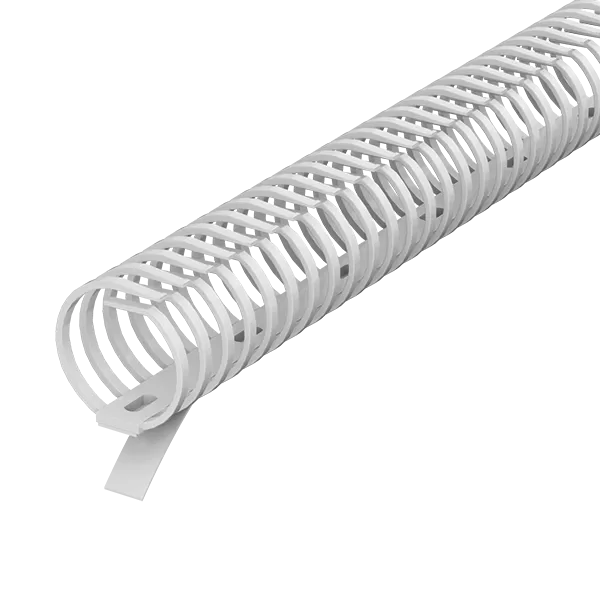
Flexible cable duct
Multi-compartment trunking
Floor cable duct
This distinction is particularly important for international sourcing because the terms wire duct, cable duct, trunking, ducting, and raceway are used differently across markets.
ABB, for example, describes wiring duct and trunking as products used for routing and concealing wiring in control panels, with configurations available in PVC and halogen-free materials.
PVC is widely used because it can be formed into stable, lightweight profiles with smooth surfaces and consistent slot geometry. It also provides electrical insulation and resistance to moisture and many common industrial substances.
Important characteristics to evaluate include:
The duct material should have flame-performance data appropriate for the installation. Buyers should not assume that every PVC product has the same flame classification. The technical documentation must correspond to the actual duct series and material formulation being supplied.
Applications with stricter fire and smoke requirements may require low-smoke, halogen-free alternatives rather than standard PVC. TE’s wiring duct range, for example, distinguishes between PVC products for standard industrial applications and halogen-free products for environments such as railways, marine facilities, high-rise buildings, and public buildings.
The expected cabinet temperature must remain within the product’s specified operating range. Heat from drives, transformers, power supplies, and densely installed conductors may raise the internal temperature above the general room temperature.
Prolonged exposure outside the specified range can affect duct shape, finger strength, impact resistance, or cover retention.
PVC ducts can be suitable for humid environments, but very wet, corrosive, or chemically aggressive conditions require additional evaluation. Enclosure protection, surface contamination, cleaning chemicals, oils, and solvents can all affect long-term performance.
EASCO states that its PVC ducts are moisture-resistant and can be used in humid environments, while additional protection may be required under extremely wet conditions.
For panel manufacturers and OEM buyers, dimensional consistency is as important as the nominal size. Variations in width, height, wall thickness, slot spacing, or cover fit can disrupt automated cutting, cabinet layouts, and assembly procedures.
A reliable supplier should be able to provide dimensional drawings, tolerances, material information, and production samples before a larger order is confirmed.
Installation should begin only after the positions of DIN rails, terminals, contactors, protection devices, ventilation openings, and cable entry points have been confirmed.
The duct should be positioned close enough to the electrical components to avoid long unsupported wire sections. At the same time, sufficient space must remain for labels, terminals, tools, and cover removal.
The wire exit direction should match the connection side of the equipment. Placing a duct above a component is inefficient when all conductors connect from below. Good panel layout begins by examining how each cable interfaces with the installed hardware.
Use a suitable wiring-duct cutter or fine-tooth cutting tool. The cut should be square, and all burrs should be removed.
A poor cut can cause:
Sharp edges near cable insulation
Misaligned duct sections
Covers that do not fit correctly
Cracked fingers
Visible gaps at corners and joints
The channel should be installed on a clean, flat mounting surface. Mechanical fasteners are commonly preferred in industrial panels, particularly where vibration, higher temperatures, or large cable loads are expected.
Adhesive-backed products may be suitable for lighter installations, but the adhesive must be compatible with the mounting surface and operating environment.
EASCO recommends using suitable screws, adhesive strips, or mounting hardware and ensuring that the mounting surface is clean and dry.
Cables should not be forced through a slot or around a corner at a bend radius smaller than the cable manufacturer permits. Sharp bends can increase stress on conductors, insulation, shielding, and terminations.
At corners, installers may use separate duct sections, corner accessories, or planned gaps that allow the cable bundle to change direction smoothly.
After all cables have been installed, confirm that:
No cable extends above the duct walls
The wire bundle does not press against the cover
The cover engages evenly along the complete duct
Individual conductors can still be identified
Power and signal circuits remain appropriately separated
No sharp cut edges contact the wiring
The cover should remain secure during normal operation but should not require excessive force to remove.
Power and data cables should only share a duct when the system design and applicable requirements permit it. In many applications, physical separation is recommended to reduce electrical interference and simplify maintenance.
The decision should consider:
Voltage difference
Current level
Signal sensitivity
Cable shielding
Communication protocol
Earthing arrangement
Manufacturer requirements
Applicable electrical standards
Where a larger PVC cable duct must carry different cable groups, an internal divider may be used. EASCO’s PVC wiring duct range includes separate duct dividers intended for organized cable separation.
A divider should not be treated as a substitute for an engineering assessment. High-voltage conductors and sensitive data cables may still require separate ducts or greater spacing.
A complete purchasing specification should include the following information:
Required duct type
External and internal dimensions
Slot width and slot spacing
Finger thickness and breakability
Standard section length
PVC material grade
Flame classification
Operating temperature range
Colour
Cover type
Mounting-hole design
Required accessories
Compliance documents
Packaging quantity
Dimensional tolerances
Order volume
Buyers should also confirm whether covers are included with the duct or supplied separately. For large projects, test the cover fit and finger strength on production samples rather than relying only on catalogue photographs.
Terms such as kabel duct, kabel ducting PVC, wiring cable duct PVC, and ducting cable PVC may all appear in inquiries, but they do not define the complete technical requirement. A precise specification reduces quotation errors and ensures that the supplied product fits the intended cabinet design.
A dependable supplier should provide stable material quality, consistent dimensions, accurate technical data, and appropriate product options for different panel layouts.
Key capabilities include:
Multiple slot and wall configurations
Stable cover engagement
Smooth, insulation-safe edges
Consistent colour and material formulation
Reliable dimensional tolerances
Product drawings and test documents
Accessories such as covers, dividers, and wire retainers
OEM size or colour support where required
Packaging suitable for long profiles
Production consistency across repeat orders
For distributors and equipment manufacturers, supply continuity also matters. Changing the duct profile after a panel design has been approved can affect hole positions, component spacing, wiring capacity, and assembly instructions.
EASCO currently lists open-slot, finger-breakable, and solid PVC duct options, as well as covers and dividers, allowing buyers to select a configuration according to the cable route and installation method.
Only when the selected duct is rated for the actual outdoor conditions. UV exposure, moisture, temperature variation, impact, and enclosure protection must all be evaluated. Standard panel duct should not automatically be treated as an exposed outdoor raceway.
Yes. It is commonly cut to match the panel layout. The installer should use a suitable cutting tool and remove all burrs before routing the cables.
Many PVC products tolerate humidity, but very wet or continuously exposed environments may require additional enclosure protection, drainage, sealing, or a different cable-management solution.
A PVC duct is generally a rectangular channel with a removable cover and may contain multiple cables. PVC conduit is normally a tubular enclosed raceway through which wires are pulled. Duct is usually easier to open for modifications, while conduit offers a more fully enclosed cable path.
Common causes include overfilling, an incorrectly matched cover, distorted duct walls, poor cutting, insufficient fastening, or material deformation caused by excessive temperature. The cable load and product dimensions should be checked before replacing only the cover.
The correct PVC wiring duct should match the cable volume, cabinet layout, wire exit positions, environmental conditions, and maintenance requirements. Slotted products are generally preferred in control panels with frequent cable branching, while solid-wall products are effective for continuous cable routes and stronger containment.
Whether buyers search for PVC wiring ducts, PVC cable duct, cable duct PVC, kabel duct PVC, or PVC duct for electrical cables, the purchasing decision should be based on technical details rather than terminology alone.
Internal capacity, slot design, edge quality, cover retention, material performance, dimensional consistency, and supplier documentation all affect the reliability of the final installation. Evaluating these factors before ordering helps panel builders create cable routes that are easier to assemble, inspect, modify, and maintain.